
Kamehameha I, name Paiea at birth, meaning “Hard-Shelled Crab,” also known as Kamehameha the Great, was the founder and first ruler of the Kingdom of Hawaiʻi. He is greatly admired by many. Full name is Kalani Paiʻea Wohi o Kaleikini Kealiʻikui Kamehameha o ʻIolani i Kaiwikapu kauʻi Ka Liholiho Kūnuiākea.
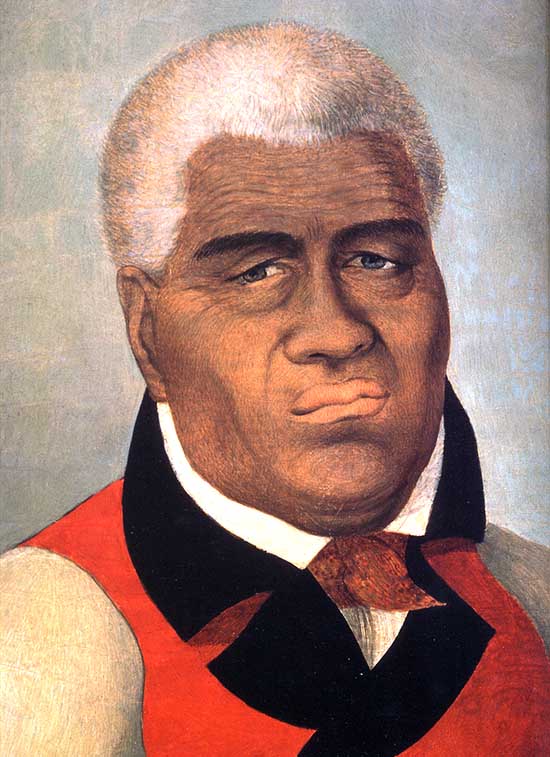
King Kamehameha I Day on June 11 is a public holiday in Hawai’i to honor the man who established the Kingdom of Hawaiʻi — comprising the Hawaiian Islands of Niʻihau, Kauaʻi, Oʻahu, Molokaʻi, Lānaʻi, Kahoʻolawe, Maui, and Hawaiʻi (Big Island).
UPDATE 6.11.25: World Renowned Historian John Wehrheim Warns about Kings
The current president, Dictator Don, seeks to be a king. How do you like living under a king? MAGA RETARDS love him, because he is their king. Similarly, those who benefited from Kamehameha loved the murderous, greedy king.
I am astonished that folks on Kauai celebrate Kamehameha Day—unless their family has 18th-century roots on the Big Island. Kamehameha, a usurper and bloodthirsty warlord, slaughtered his way across the islands. Kauai, protected by the gods, was the only island he couldn’t conquer by force.
So, the Kamehamehas used deception. After the death of his father, Liholiho (Kamehameha II) sailed his pleasure yacht, Cleopatra’s Barge, to Kauai for a friendly visit, inviting Kauai’s King Kaumuali’i aboard for dinner.
As they ate, Liholiho’s crew weighed anchor and kidnapped Kaumuali’i, sailing to Oahu, where the Kauai King was forced to marry Ka’aumanu, the Regent and Kamehameha I’s favorite wife. Kaumuali’i’s lineage was sacred, far more powerful than the Kamehameha’s, and this union would add mana and legitimacy to the Kamehameha reign.
When the Kauai chiefs rebelled, demanding the return of their King, Liholiho sent an overwhelming force to slaughter Kauai’s ali’i. Take a look at the Land Court Award map of Kauai, drawn during the Mahele, and you will see that all our ahupua’a were awarded to the Kamehameha’s, their relatives and retainers—none to Kauai people.
By celebrating Kamehameha Day, the people of Kauai celebrate the historic loss of their King, their sovereignty, and their land.
PS: As you can read here, the missionaries, or “the haole,” did not steal Kauai’s land. The Kamehamehas did. And sold it to them… When students are taught a past that not only never was, but due to human nature, never could have been, the present will make no sense; it will be hard for them to know themselves. Feeling the lies, they will become confused and frustrated.
John Wehrheim

SOURCE: John Wehrheim
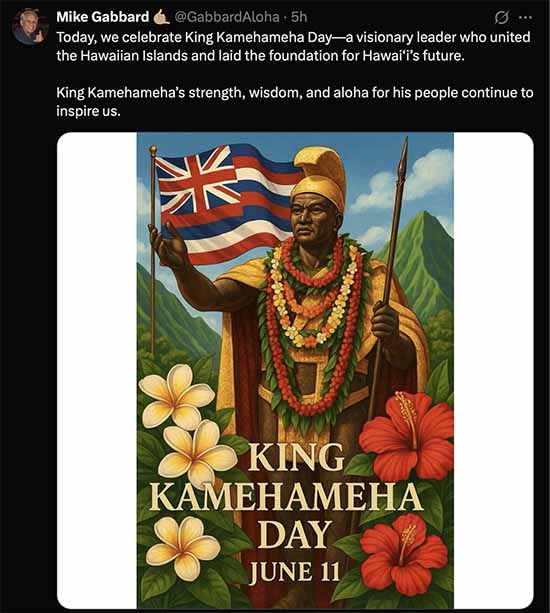
Tulsi Gabbard’s father, the man who led the cause to BLOCK gay civil unions in Hawai’i, now shows his support for a king; his daughter works for a man who wants to be king: DICK Dictator Don
Today, we celebrate King Kamehameha Day—a visionary leader who united the Hawaiian Islands and laid the foundation for Hawai‘i’s future. King Kamehameha’s strength, wisdom, and aloha for his people continue to inspire us.
Mike Gabbard, unAmerican politician in Hawai’i
Supported Mike, donated to his campaign; served Tulsi in her 2020 presidential run as a DEMOCRATIC candidate, and voted for her as my DEMOCRATIC congresswoman. Both became frustrated and turned to the Dark Side. Neither can be trusted today.
Kamehameha changed the destiny of the Polynesian people in Hawai’i. His march began about 1780. USA ratified its constitution in 1787. Thirteen states agreed to cooperate and work together freely in common pursuit of life, liberty and happiness. The people united to keep monarchy out — not start one. Imagine had the various states followed the example of Kamehameha and instead allowed one strong man to force monarchy on the people.
Kamehameha used force and violence to unify the islands under his command. Consider George Washington, Virginia, assembling a state militia, and attacking townships in North Carolina to subjugate people to his rule. Imagine Washington further pressing his troops south into Florida and Georgia. Kings do that. Participatory democracies do not. They spend less on internal domination and focus more on teamwork and cooperation. How could they trade with each other? How could they help each other grow and prosper?
Great leaders and valuable warriors would have been lost on all sides; resources diverted to war machines, navy, army and advanced weaponry. Would be high costs simply to control and claim ownership of the states. Kamehameha’s campaign to control all the islands was extremely costly. Fate first introducted Kamehameha to the British. He followed the evolutionary model of the kings; not the participatory example of Americans.
Now, imagine Kamehameha patterning instead after the American experiment in cooperative enterprise. Big Island could have specialized in ranching and farming. Maui to provide agriculture and fruit. Kaua’i the provider of poi and maker of canoes. O’ahu designated for fish farming, for example. Why kill each other simply for control and ownership? Cohesion between Kānaka throughout the islands didn’t fully develop. Political infighting, war machines and division plagued the budding kingdom.
The question asked is whether this holiday honors a man of vision or one who took the Kānaka down a dark path? Each year, as set through royal decree on December 22, 1871, by King Kamehameha V, Kānaka celebrate the king’s great-grandfather. By most accounts, Kamehameha was born in Ainakea, Kohala, Hawaiʻi.
History of the Kingdom of Hawai’i
Finally forcing Kaua’i to bow to his rule, Kamehameha established the Kingdom in 1810. Designed the Hawaiian flag in 1816, including the British Union Jack signifying the colonial relationship he established with England. This first flag of the kingdom was all red with the British Union Jack in upper left corner, as flown by a number of British colonies (shown below by Altas Press).
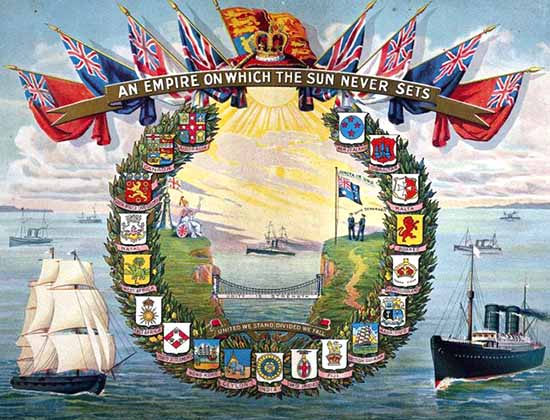
SOURCE: AtlasPress
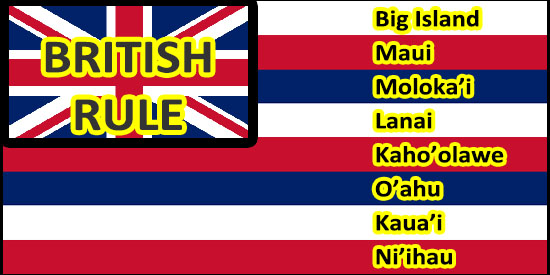
Kamehameha designed his flag to incorporate the eight major islands: Hawai’i (Big Island), Maui, Moloka’i, Lanai, Kaho’olawe, O’ahu, Kaua’i and Ni’ihau. Many groups of Polynesians paddled and sailed to the various islands. They were separate people and cultures. They did not want to be part of Kamehameha’s kingdom; and people forced at the point of a gun or cannon will never be loyal.
In 1826, by treaty, the USA was the first nation to recognize Kingdom of Hawai’i independence. In 1843, USA warships pushed out British and French forces. This event is celebrated annually on November 28, as Lā Kū’oko’a — Sovereignty Restoration Day. USA gave Kānaka independence and freedom.
USA didn’t want to own the islands. Americans were strategically interested only in Pearl Harbor. By treaty USA acquired rights to this valuable naval asset in 1875. They issued the Kingdom special sugar trading privileges from tariffs, which made the monarchy and kingdom wealthy. Kanaka monarchy had no gold, diamonds, silver or oil deposits. Sugar became island gold. Tourism is gold today.
Due in part to lavish tax and spending habits of King David Kalākaua, local residents, kama’aina, under the banner of the Honolulu Rifles demanded a new constitution in 1887. The ‘Iolani Palace was amazing. Had electric light before the White House. Kalākaua however didn’t have personal wealth. He demanded the people fund his exquisite parties of state and world tours, pay to send royal keiki to the finest schools in the world, and support a privileged lifestyle for the monarchs.
Residents rebelled and limited the monarchy to a ceremonial royal, as in England. The legislature (Parliament) would govern the island kingdom. Queen Lili’uokalani, David Kalākaua’s sister Lydia, attempted to undo this agreement in 1893. She demanded a return to full power and recommended funding the kingdom with a national lottery and sales of opium. Locals considered her to be a kook.
The Committee of Thirteen imprisoned Lydia for treason. Kingdom of Hawai’i Supreme Court Justice Sanford Dole wrote the articles. She was a beautiful queen, deeply sincere and compassionate. Lydia simply didn’t have many political allies or a strong army. Due to Kamehameha, there was little unity in the kingdom. Various Kānaka communities preferred to be left alone.
On January 16, 1893, United States troops invaded the Hawaiian Kingdom without just cause, which led to a conditional surrender by the Hawaiian Kingdom’s executive monarch, Her Majesty Queen Lili‘uokalani.
FALSE CLAIMS by Keanu Sai
Historians sympathetic to Kamehamehas and Kalākauas claim the US government illegally invaded Hawai’i in 1893. Narrative is false. None speak of the riots in Honolulu in 1874. Keanu Sai, who received his PhD at the University of Hawai’i, is a leading contributor to this false and defamatory accusations. The National Education Association gives him a forum.

This example shows why current president and MAGA are defunding higher education. It’s unclear why so many academic institutions further false accounts of history that disparage Americans and the United States. This behavior is despicable because it divided citizens and creates negativity. Definitely does not follow the Aloha Spirit principles of the Hawai’i islands.
Due to the untimely death of King Lunalillo on February 3, 1874, who left no successor, supporters of Queen Emma (Emmalites) attacked followers of David Kalākaua. Massive riots and violence broke out in the islands. (SEE Honolulu Courthouse riot)
Local authorities lost control and pleaded with American Minister Henry A. Pierce for assistance. Marines and sailors from three American and British warships were landed and successfully quelled the rioters. David Kalākaua took the oath of office the following day without further opposition.
In 1893, political conditions deteriorated as in 1874. Violence and rioting appeared likely, local authorities requested American Minister John L. Stevens summon Americans marines from the anchored USS Boston. About 120 marines came ashore. None fired weapons. There was little violence. No people were harmed or hurt. There was no coordination with President Grover Cleveland or the US Congress in Washington, D.C.
In addition, while there had been about 800,000+ Kānaka in 1780, only some 40,000 remained at the time of the upheaval. Kamehameha’s wars and the introduction of germs and disease from outsiders had decimated the Kānaka population.
In 1894, kama’aina officials formed the Republic of Hawai’i, selecting Sanford Dole, as the first and only president. Queen Lili’uokalani and some 19 foreign nations formally recognized the Republic in 1895. USA annexed Hawai’i by agreement with the Republic of Hawai’i, along with the Philippines and Puerto Rico, into territorial jurisdiction in 1898.
Jonah Kūhiō Kalanianaʻole was the “last” prince of the Kingdom of Hawaiʻi. He was elected as the representative of the Territory of Hawai’i, and served as a non-voting delegate to the US Congress. Kalanianaʻole remains the only royal-born member of Congress. “The Prince” called for statehood in 1920. Residents of the territory voted to join the union as the 50th US state in 1959, with overwhelming support of 93% of voters.

The Beautiful People
Today, Kānaka ʻōiwi or Native Hawaiians (also called Kānaka maoli) claim Kamehameha united the islands. They remember that native Polynesians communities at the time of Kamehameha’s birth were constantly fighting. From their perspective, Kamehameha ended this bickering and violence. Kamehameha had inherited the cultural and iconic war god. Prophesy foretold one would bring peace through unification.
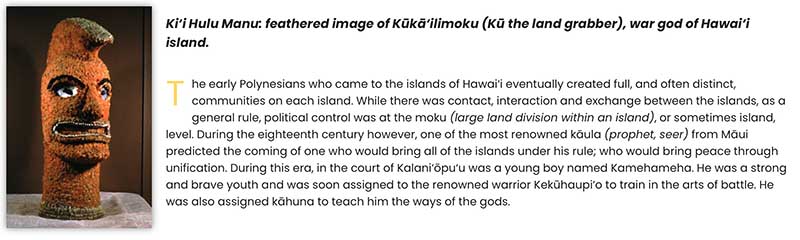
The early Polynesians who came to the islands of Hawai‘i eventually created full, and often distinct, communities on each island. While there was contact, interaction and exchange between the islands, as a general rule, political control was at the moku (large land division within an island), or sometimes island, level.
https://hawaiialive.org/kukailimoku/
Unification however doesn’t always mean united. The Great One may have “unified” a Kingdom of Hawaiʻi. Not clear he “united” the Kānaka. The Kānaka are a beautiful people. They flourished in the isolated lands hidden deep in the middle of the northern Pacific. Likely they would have preferred to remain anonymous and unknown. The world was rapidly shrinking. Kamehameha wanted to be part of the global community. He marched the Kānaka into the future. The Kānaka would have preferred to remain in the past.
Ceding Control to England
Kamehameha ceded control over Big Island to the British in 1790, to acquire British foreign aid, long guns and cannons. Kamehameha recognized the efficacy of foreign aid and sought assistance from Captain George Vancouver, a dedicated “man of empire.” Vancouver convinced Kamehameha that the British would help protect the islands. Kamehameha betrayed the Kānaka allowing the British to establish a colonial presence in Hawai’i.
From about 1780 until 1810, Kamehameha’s campaign of violence killed 10,000s of Polynesians. There has never been unity between the various groups of people living in the eight major islands. They came to the Sandwich Islands from numerous island groups and remote places. Forcing Kānaka into his kingdom didn’t unify the various social groups. Although they bowed to his rule, forcing Kānaka to their knees did not result in respectful and loyal alliances.
As Kamehameha’s military aggression lasted nearly 30 years, generations of young, talented Kānaka males and future leaders were lost during the period. Rival chiefs were killed. Removing opposition individuals and groups also diminished the talent pool in the islands. Hawai’i is isolated — the most remote spot in the world. Killing Kānaka, losing 100,000s to disease, ensured that those immigrating from foreign locations would become the innovators and social leaders.
War campaigns of Kamehameha and rival chiefs also depleted precious resources that could have been channeled to Kānaka needs in a changing world. Rather than inspiring Polynesian inhabitants to build schools and hospitals, further education and medical sciences, and protect Kānaka culture and land from outsiders, Kamehameha’s left a legacy of violence and aggression. This robbed the kingdom of many of the Best & Brightest.
Kamehameha died in 1819. His life was characterized by death and bloodshed. He personified the war god Kuka’ilimoku.
For those who have visited the islands, ask yourself what motivated these Polynesian MEN to engage in war in the first place? Each of the eight major islands in Hawai’i are Paradise. Perfect weather, plenty fresh water, bountiful land blessed to nurture and grow any crop, fruit or vegetable, and unlimited fish and creatures available in the surrounding ocean.
Only madmen shoot children in schools; and only madmen paddle 90+ miles through treacherous Pacific waters to wage war on other villages for no reason but greed, ego and personal ambition.
Had Kamehameha prosecuted war to prevent outsiders from landing or residing in the islands, the world would sympathize with his actions. Indigenous tribes of North America fought valiantly to slow the spread of European migration. Kamehameha did not.
As documented, Kamehameha traded with foreigners and encouraged outsiders to more deeply integration into local culture. He did not work to keep foreigners out. Kānaka kings and queens instead invited outsiders to live in the islands and partner with them. The monarchy had land. Outsiders had money, could provide modern services, and most importantly, weapons of mass destruction.
Political Upheaval
A militia of about 500 Hawaiian, European and American business and plantations owners, the Honolulu Rifles, bullied King Kalākaua into signing a new constitution in 1887.
The Bayonet Constitution neutered the monarchy, just as the wars of Kamehameha had neutered the male warrior class. Kamehameha splintered the paddle — pledging not to kill elderly, women or children — but left few capable or willing to fight for the monarchy.
There was only minimal protest when the Royalists were challenged. Kalākaua didn’t resist, which frustrated sister Lydia into conspiring to remove her brother from power; nor did Kalākaua demand change during the years until his death in 1891. Even the Wilcox rebellion in 1895 could only field an insurgent force of around 70 Kānaka. [source]
The misrepresentation and admiration of Kamehameha’s legacy therefore triggers more anger and animosity in the islands. It was Kamehameha who conquered and killed; Kamehameha who colonized islands against the will of inhabitants and their chiefs; and Kamehameha who planted the seeds for the eventual usurpation of this island chain. [source]
Blaming people today who had nothing to do with these events does not alter the facts of history. Americans in Hawai’i for example do not blame young Japanese children for the attacks on Pearl Harbor.
As we suffer too often in America today, the monarchy put profits before the people in their kingdom. Waging military campaigns for 30 years, building royal palaces and offices, sending emissaries around the globe and keiki to the most prestigious foreign schools cost money.
Supplies of sandalwood lasted only a few years. Land rights and later the vote became the currency for international recognition and support for royal rule. Infighting destroyed the aloha kingdom.
King Kamehameha Was a Murderer, not a Uniter
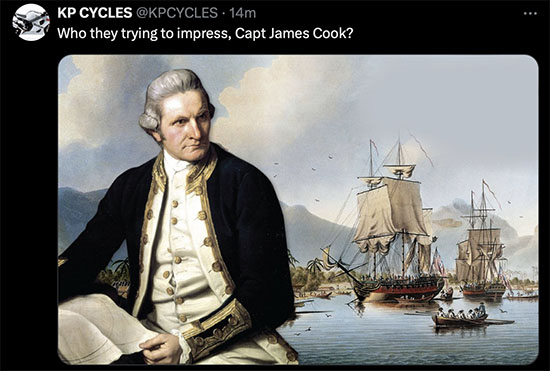
By the time of British Captain James Cook’s arrival in Hawai’i [1778], Kamehameha had become a skilled warrior who already carried the scars of a number of political and physical encounters. The young warrior was described as a tall, strong, and physically fearless man who “moved in an aura of violence.”
From the Pu’ukohola Heiau National Historic Site, we learn [source]:
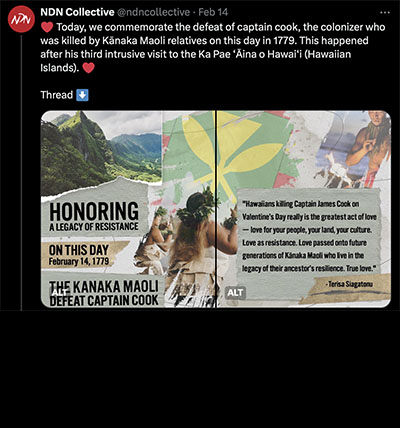
Kamehameha accompanied his uncle (Ali’i Nui Kalani’opu’u) aboard the Discovery in February 1779, and history records that he conducted himself with valor during the battle in which Cook was killed. The Kānaka stole one of Discovery’s long boats, and Cook led a shore party to get the boat returned. The Kānaka celebrate each February 14th with joy, as this day represents the murder of Captain James Cook.

Recorded history from British ship logs provide a more accurate account of the unfortunate encounter. On February 4, 1779, the British ships left Kealakekua Bay on Big Island, but rough seas damaged the foremast of the Resolution, and after only a week at sea the expedition was forced to return to Hawai’i.
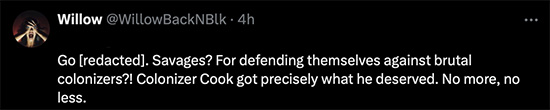

The Hawaiians greeted Cook and his men by hurling rocks; they then stole a small cutter vessel from the Discovery. Negotiations with Ali’i Nui Kalani’opu’u for the return of the cutter collapsed after a lesser Hawaiian chief was shot to death. [source]

The captain and his men fired on the Hawaiians, but they were soon overwhelmed, and only a few managed to escape to the safety of the Resolution. Captain Cook himself was killed. A few days later, the Englishmen retaliated by firing their cannons and muskets at the shore, killing some 30 Hawaiians.
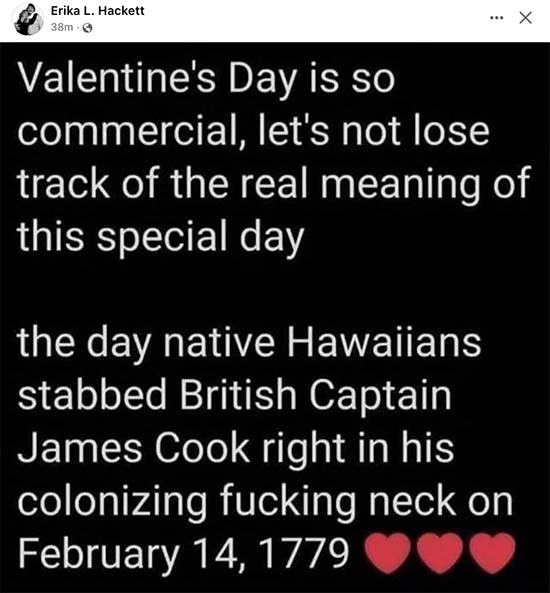
After sharing the accurate and complete story, Erika L. Hackett reported that she appreciated learning the truth about the life and death of British Captain James Cook.

For his part in the battle at Kealakekua Bay, Kamehameha achieved a certain level of notoriety, which he paraded “with an imperiousness that matched and even exceeded his rank as a high chief.”
Kamehameha learned of the awesome power of the European firearms, during an attempt to land by a small boat which Cook had dispatched to discover a suitable landing place, a native chief tried to secure the anchor, and was immediately shot by Lieutenant Williamson.

This was the first time that the natives had observed a firearm in action and their respect for it became great. Pogue gives an account of the reaction of the natives, and their surprise and horror at the power of guns: “When the people were fired upon, they held up their mats for protection, but the bullets were not estopped to their distress and tragedy.” [source]
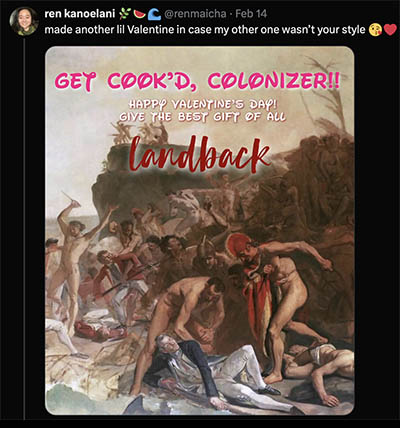
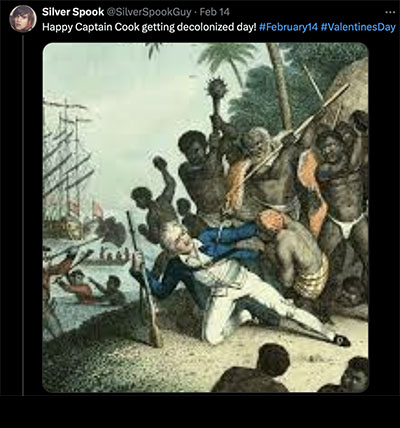
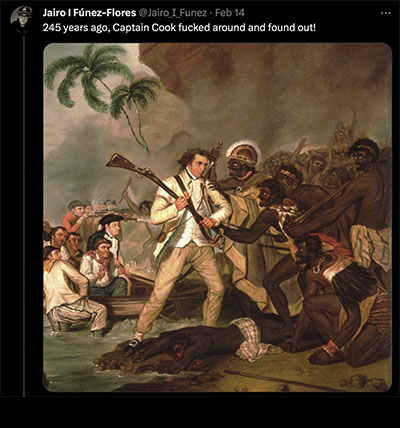
And on February 14, 1779, Native Hawaiians killed famed explorer Captain James Cook. Cook had not wronged Kānaka. Kānaka celebrate this day. Truth is Kānaka STOLE Cook’s long boat. MURDERED Cook when he tried to retrieve legal property. British told the world Kānaka were thieves, murderers and savages. One never gets a second chance to make a good first impression. British returned to assist Kamehameha colonize the Sandwich Islands (Hawai’i). 
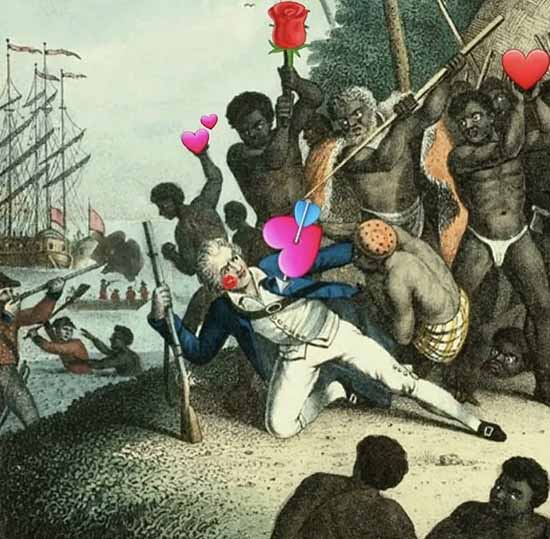
Imagine had the Kānaka simply returned the long boat. Captain Cook would have reported to the world how Native Hawaiians were honorable, kind and advanced human beings. Kānaka are proud of their murder and thievery! Kamehameha soon colonized the savage people partnering with the British.

When asked as to how the Hawaiians had felt after the death of Captain Cook, John Young intimated that he had been told that they were afraid that the English would later return with a large force and wreak a merited revenge. But now they were so confident in their own strength that they bid defiance to any force that could be sent against them. [source]

In 1795, Kamehameha laid down an edict prohibiting Kānaka from disposing of hogs and other refreshment to European and American visitors under penalty of death, except for arms and ammunition.
Social Media Images Posted by Kanaka to Celebrate Death of Captain Cook
As history records, Captain James Cook was not a colonizer or engaged in colonizing the islands. Cook rose to fame for his genius in map making and designing healthy diet and nutrition programs for his crews. As a commoner in England, an individual like Cook would be denied a position as a captain. His superior skills however forced the British to promote him to captain — scandalous at the time.
Cook was also recognized for his wisdom and compassion when encountering new cultures of people. His concerns about harmonious and positive encounters with indigenous groups motivated Cook to lead most shore parties when relations were unpredictable. Cook’s protocol placed him in harms’ way on the fateful 14th of February 1779, when the Kānaka on Big Island murdered him. The unfortunate incident cost the world a truly remarkable explorer and human being.
Many visitors to the Sandwich Islands, as Cook christened them at the time, considered the indigenous tribes to be savages. Modern Kānaka who celebrate the untimely and unjust death of Captain James Cook are savages as well. Outsiders came to the islands with the blessings of Kamehameha and rival chiefs. They remained by invitation of local leaders. Some married Kānaka women and propagated generations of new island inhabitants — called kama’aina.
The Hawaiian islands were never colonized by foreign powers. Kānaka simply begged outsiders to help them modernize, and traded land and political power for their consulting services.




Kamehameha easily and almost readily made friends with foreign visitors. He saw the advantage of this, in his desire to promote his chief ambition. In 1802, Captain John Turnbull, a visitor to Hawai’i, remarked: “Kamehameha’s grand and favorite object was the establishment of a large military and naval force.”
Kamehameha partnered with many Europeans, skilled artisans of foreign extraction, men as John Young, Isaac Davis, George Beckley, Archibald Campbell, James Boyd, Peter Corney, John Har-bottle, and Alexander Adams formed his Board of Strategy. Another European man to whom Kamehameha became much attached was Captain George Vancouver of the English Navy, whose men built the first Hawaiian warship in 1794. [source]
Kamehameha’s army consisted of disciplined troops, who trained regularly in the ancient war games and modern drills, and who went on duty with the drum and fife and relieved each other as in Europe, calling out, “All is well” at every half hour, as on board ship. They wore a blue-gray coat with yellow facings, and kept time by an hour glass which was held by one of the guards.
By 1804, Kamehameha had some 60 pieces of artillery and 600 muskets. By 1806, army equipment increased to more than of 2,000 stand of arms, upwards of $12,000 in cash, and other valuable articles in proportion deposited in storehouses and underground arsenals.
At this time also, Kamehameha had between 200 and 300 body guards to attend him, independent of the number of chiefs who were required to accompany him on all his voyages and expeditions. This strategy prevented them from starting rebellions.
As to his navy, Kamehameha had the largest naval force in the entire Pacific during his time. In 1795, Kamehameha had a fleet of 20 vessels, tonnage of from 20 to 40 tons. Each vessel was well armed and manned. John Harbottle, an experienced seaman, was his Admiral; James Boyd, his shipwright, and Archibald Campbell his sailmaker. By 1802, he acquired more than 25 vessels of various sizes, from 20 to 75 tons, of which a number were copper-bottomed. [source]
In return for this foreign assistance, Kamehameha formally ceded the Island of Hawai’i to England but this agreement was never ratified by England.
Frances “Deadly SoverAuntie” misrepresents the British and Captain Cook. The British didn’t colonize the islands. Chief Kahekili first partnered with English merchant William Brown to acquire military aid by ceding O’ahu, perhaps Kaua’i to the British. Then Kamehameha partnered with the Isaac Davis (Welsh) and John Young to learn modern military tactics and how to use long guns and cannons by ceding Big Island to the British. As documented, Kānaka chiefs traded Hawaiian islands to the British for weapons and military aid.

Kamehameha might never have become king except for a twist of fate. Within a year after Cook’s death, the elderly ali’i Kalani’opu’u, crippled by age and disease, called together his retainers and divided his Hawaiian domain.
His son Kiwala’o became his political heir. To his nephew Kamehameha, the elderly ali’i entrusted the war god Kuka’ilimoku. Although this pattern of dividing the succession of the chiefdom and the protectorate of the god Ku was legendary, some authors suggest it was also uncommon.
As the eldest son, a chief of high rank, and the designated heir, the claim of Kiawala’o to the island of Hawai’i was “clear and irrefutible.”
However, although Kamehameha was of lower rank, and only a nephew of the late king, his possession of the war god was a powerful incentive to political ambition.
Thus the old chief’s legacy had effectively “split the political decision-making power between individuals of unequal rank” and set the stage for civil war among the chiefs of the island of Hawai’i.
Although Kiwala’o was senior to Kamehameha, the latter soon began to challenge his authority. During the funeral for one of Kalani’opu’u’s chiefs, Kamehameha stepped in and performed one of the rituals specifically reserved for Kiwala’o, an act that constituted a great insult.
After Kalani’opu’u died, in 1782, Kiwala’o took his bones to the royal burial house, Hale o Keawe, at Honaunau on the west coast of Hawai’i Island. Kamehameha and other western coast chiefs gathered nearby to drink and mourn his death.
There are different versions of the events that followed. Some say that the old king had already divided the lands of the island of Hawai’i, giving his son Kiwala’o the districts of Ka’u, Puna, and Hilo. Kamehameha was to inherit the districts of Kona, Kohala, and Hamakua.
It is not clear whether the landing of Kiwala’o’s at Honaunau was to deify the bones of Kalani’opu’u or to attempt seizure of the district of Kona. Some suggest that Kamehameha and the other chiefs had gathered at Honaunau to await the redistribution of land, which usually occurred on the death of a chief, and to make hasty alliances.
When it appeared that Kamehameha and his allies were not to receive what they considered their fair share, the battle for power and property began.
Over the next four years, numerous battles took place as well as a great deal of jockeying for position and privilege. Alliances were made and broken, but no one was able to gain a decisive advantage.
The rulers of Hawai’i had reached a stalemate. Kamehameha’s superior forces had several times won out over those of other warriors. He took the daughter of Kiwala’o, Keopuolani, captive and made her one of his wives; he also took the child Ka’ahumanu (once mentioned as a wife for Kiwala’o) and “betrothed her to himself.”
Kamehameha had many wives. The exact number is debated because documents that recorded the names of his wives were destroyed. Bingham lists 21, but earlier research from Mary Kawena Pukui counted 26. In Kamehameha’s Children Today authors Ahlo, Johnson and Walker list 30 wives: 18 who bore children, and 12 who did not. They state the total number of children to be 35: 17 sons and 18 daughters. While he had many wives and children, his children through his highest-ranking wife, Keōpūolani, succeeded him to the throne.
https://en.wikipedia.org/wiki/Kamehameha_I
In Ho`omana: Understanding the Sacred and Spiritual, Chun stated that Keōpūolani supported Kaʻahumanu’s ending of the Kapu system as the best way to ensure that Kamehameha’s children and grandchildren would rule the kingdom.
He thus firmly established himself as an equal contender for control over the Hawaiian lands formerly ruled by Kalani’opu’u. Eventually Kiwala’o was killed in battle, but control of the Island of Hawai’i remained divided.
By 1786 the old chief Kahekili, king of Maui, had become the most powerful ali’i in the islands, ruling O’ahu, Maui, Moloka’i, and Lana’i, and controlling Kaua’i and Ni’ihau through an agreement with his half-brother Ka’eokulani.
In 1790 Kamehameha and his army, aided by Isaac Davis and John Young, invaded Maui. The great chief Kahekili was on O’ahu, attempting to stem a revolt there.
Using cannon salvaged from the ship, The Fair American, Kamehameha’s warriors forced the Maui army into retreat, killing such a large number that the bodies dammed up a stream.
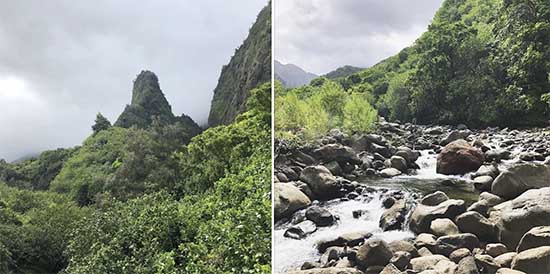
However, Kamehameha’s victory was short-lived, for one of his enemies, his cousin Keoua, chief of Puna and Ka’u, took advantage of Kamehameha’s absence from Hawai’i to pillage and destroy villages on Hawai’i Island’s west coast.
Returning to Hawai’i, Kamehameha fought Keoua in two fierce battles. Kamehameha then retired to the west coast of the island, while Keoua and his army moved southward, losing some of their group in a volcanic steam blast.
This civil war, which ended in 1790, was the last Hawaiian military campaign to be fought with traditional weapons. In future battles Kamehameha adopted Western technology, a factor that probably accounted for much of his success.
Because of Kamehameha’s presence at Kealakekua Bay during the 1790s, many of the foreign trading ships stopped there. Thus he was able to amass large quantities of firearms to use in battle against other leaders.
However, the new weapons were expensive and contributed to large increases in the cost of warfare.
After almost a decade of fighting, Kamehameha had still not conquered all his enemies. So he heeded the advice of a seer on Kaua’i and erected a great new heiau at Pu’ukohola in Kawaihae for worship and for sacrifices to Kamehameha’s war god Ku.
Kamehameha hoped to thereby gain the spiritual power that would enable him to conquer the island. Some say that the rival chief Keoua was invited to Pu’ukohola to negotiate peace, but instead was killed and sacrificed on the heiau’s altar. Others suggest that he was dispirited by the battles and was “induced to surrender himself at Kawaihae” before being killed.
His death made Kamehameha ruler of the entire island of Hawai’i. Meanwhile, Kahekili decided to take the advantage while Kamehameha was preoccupied with Keoua and assembled an army — including a foreign gunner, trained dogs, and a special group of ferociously tattooed men known as pahupu’u.
They raided villages and defiled graves along the coasts of Hawai’i until challenged by Kamehameha. The ensuing sea battle (Battle of the Red-Mouthed Gun) was indecisive, and Kahekili withdrew safely to O’ahu.
Shortly thereafter, the English merchant William Brown, captain of the thirty-gun frigate Butterworth, discovered the harbor at Honolulu. Brown quickly made an agreement with Kahekili. The chief “ceded” the island of O’ahu (and perhaps Kaua’i) to Brown in return for military aid.
Kamehameha also recognized the efficacy of foreign aid and sought assistance from Captain George Vancouver. Vancouver, a dedicated “man of empire,” convinced Kamehameha to cede the Island of Hawai’i to the British who would then help protect it.
Kamehameha spent the next three years rebuilding the island’s economy and learning warfare from visiting foreigners.
Upon Kahekili’s death in 1794, the island of O’ahu went to his son Kalanikupule. His half-brother Ka’eokulani ruled over Kaua’i, Maui, Lana’i, and Moloka’i. The two went to war, each seeking to control all the islands.
After a series of battles on O’ahu and heavy bombardment from Brown’s ships, Ka’eokulani and most of his men were killed. Encouraged by the victory over his enemies, Kalanikupule decided to acquire English ships and military hardware to aid in his attack on Kamehameha.
Kalanikupule killed Brown and abducted the remainder of his crew, but the British seamen were able to regain control and unceremoniously shipped Kalanikupule and his followers ashore in canoes.
Recognizing his enemy’s vulnerability, Kamehameha used his strong army and his fleet of canoes and small ships to liberate Maui and Molaka’i from Kalanikupule’s control.
Kamehameha’s next target was O’ahu. As he prepared for war, one of his former allies, a chief named Kaiana, turned on him and joined forces with Kalanikupule.
Nevertheless, Kamehameha’s warriors overran O’ahu, killing both rival chiefs. Kamehameha could now lay claim to the rich farmland and fishponds of O’ahu, which would help support his final assault on Kaua’i.
By mid-1796, Kamehameha’s English carpenters had built a forty-ton ship for him at Honolulu, and once again he equipped his warriors for battle and advanced on Kaua’i. However bad weather forced him to give up his plans for invasion.
Meanwhile yet another challenger — Namakeha, Kaiana’s brother — led a bloody revolt on Hawai’i, depopulating the area and forcing Kamehameha to return to Hawai’i to crush the uprising.
Kamehameha used the next few years of peace to build a great armada of new war canoes and schooners armed with cannons; he also equipped his well-trained soldiers with muskets. He sailed this armada to Maui where he spent the next year in psychological warfare, sending threats to Ka’umu’ali’i, Kaua’i’s ruler.
This proved unsuccessful, so early in 1804 Kamehameha moved his fleet to O’ahu and prepared for combat. There his preparations for war were swiftly undone by an epidemic, perhaps cholera or typhoid fever, that killed many of his men.
For several more years he remained at O’ahu, recovering from this defeat and, perhaps, pondering conquest of Kaua’i.
Expecting an attack from Kamehameha, Ka’umu’ali’i sought the help of a Russian agent, Dr. Georg Schaffer, in building a fort at the mouth of the Waimea River and exchanged Kaua’i’s sandalwood for guns.
However, the anticipated battle never came because an American trader convinced Kamehameha to reach a compromise with Ka’umu’ali’i. Kamehameha was acknowledged as sovereign while Ka’umu’ali’i continued to rule Kaua’i, with his son as hostage in Honolulu.
Pu’ukohola Heiau National Historic Site concludes:
After nine years at O’ahu, Kamehameha made a lengthy tour of his kingdom and finally settled at Kailua-Kona, where he lived for the next seven years. His rise to power had been based on invasion, on the use of superior force, and upon political machinations. His successful conquests, fueled by “compelling forces operating within Hawaiian society,” were also influenced by foreign interests represented by men like Captain Vancouver.
King Kalani’opu’u entrusted his nephew Kamehameha with the war god Kuka’ilimoku. “Then said Jesus unto him, Put up again thy sword into his place: for all they that take the sword shall perish with the sword.” [Matthew 26, 26:52]
Remember you heard it here first. Please leave your comments below and be sure to FOLLOW ClearHeath Life Strategies. We provide News of the News You Wish You Knew.
Ko’olau of Kaua’i. I am the Defiant One
“I Believe We Can”
 ClearHealthLife Strategies
The biggest uncle Tom in earth’s history, the murdering hypocrite used two “white” British military minded men to slaughter his own people. Not only did he kiss their asses, but he also rewarded them with tens of thousands of Hawaiian land that he wouldn’t give to his own people. The Hawaiian hypocrite uncle Tom was also responsible for introducing his people to alcohol after got his fat ass drunk on the British ship that was anchored in Cook’s bay as the white men showed him the rum stills from which the alcohol came from. The next day the Hawaiian uncle Tom had stills built all the way from Oahu to the Big island. He is responsible for all the abusive Hawaiian drunks that you see living in Hawaii today; abusive to their own families and animals. He was a cold-hearted murderer who killed women, children, all his own blood for power. And then to show his own people that he was an ass kissing uncle Tom he insisted on being painted in art wearing a Russian solders’ uniform instead of his own Hawaiian wardrove. That’s what an Uncle Tom hypocrite he was, just look at the painting above the uncle Tom in his Russian suit.
Excellent points. In conversation with a Native Hawaiian (Kanaka Maoli) today, he said British and Kamehameha were friends. In response, I said not sure friendship is the best descriptor. British were colonizing the world, not looking for friends. Kanaka had needs from the British; British wanted control in northern Pacific. France and Spain had roots in the south. Kanaka monarchy considered British to be friends; even putting the Union Jack in the flag.
Kamehameha was involved in the murder of British Captain James Cook on Big Island in 1779. Americans had a different impression of the British … as just three years earlier, 1776, we declared independence from the corrupt monarchy. Americans knew history and despised the king. Kamehameha didn’t know this history. He was duped into partnering with them; rather than UNITING Kanaka to keep them out. He saw big ships and powerful guns. He didn’t realize these shiny objects would be used to dominate politics and economic growth. Didn’t know that about alcohol. Thanks for the history!
Had Kamehameha been literate and a student of history, he would have pushed out the British and followed the American example. George Washington UNITED the 13 colonies (islands) to stand against British rule. Kamehameha unified the islands using British guns and indoctrination. Strong Ali Nui and warriors who opposed Kamehameha were killed or pushed off cliffs. Kanaka men were taught to kneel to monarchs, not live or think independently as was developing in the young United States.
George Washington was a better role model for the Kanaka than Kamehameha. Washington knew to fear the British! Kamehameha thought they were friends. Kamehameha brought in evil and the worst of humanity to the islands. The American example of tossing the monarchy and UNITING as free people was the better model.
The two British white men you are talk about were named Isaac Davis and John Young; look them up. Kamehameha rewarded them greatly for helping him MURDER his own people, millionaires in their time he made them off the land he gave them; your right about that, he didn’t unite, he conquered by death. He even allowed Young to be buried near Hawaiian scared grounds in Kawaihae while his own people would have been met with death if they even went near the place. And when Kamehameha tried to have the King of Kauai poisoned, the only King he couldn’t conquer, the King poisoned his lover Davis by mistake….LOL. Three times he tried to kill Kaumualii the Kauai king and failed, I’m from Kauai and that’s why our whole family doesn’t recognize Kamehameha as being great, we know the truth, Kamehameha was truly a murderer out for power and greed.
Kanaka of Kaua’i were NEVER conquered. Amazing people! Thanks for your comments
Hawaiians are the people of the Devil, racist rats who use to practice incest sex, ignorant fools who made rocks and sticks their gods, and to this day God almighty has cursed them for it. These animals would have sex with their own mothers, fathers, sisters, brothers, cousins, you name it as along as it was incest sex (does Sodom and Gomorrah come to mind). And when I child was born to them with any defects because of inbreeding they would drown that child immediately; image how many helpless babies these inbreed animals must have murdered throughout time. God has cursed these people to this day, most are homeless meth addicts or alcoholics who can’t even afford to live in their own land anymore because they rather cater to their addictions and hate. But here’s the funny part, the white men that Kamehameha used to kill his own people with are still in Hawaii to this day, generation upon generation buying every piece of land right under their inbreeding souls, moving them to the mainland ghettos where they belong for cursing God almighty; the truth hurts, but it is the truth, when you go against God, you will always lose.
Keep in mind that the Native Hawaiians adopted Christianity and ended the earlier practices. None of our ancestors were perfect and the TRUE Christian today knows ALL of us are sinners. Aloha and love are vibrant and alive in the islands.
Tell that to the incest loving dumbasses who made my Japanese and every other culture suffer under their own hate, racism and drunkenness. We Japanese now run and own 80% of Hawaii from Kaui all the way to the Big island. We didn’t get mad, we got even, now we’re moving their racist bullying abusive drunken asses off their own land with Japanese unite, hard work, intelligence, and real estate wealth; pay back is a bitch.
You’re correct that Masters and Servants Act 1850 turned labor into slaves. Chinese had it the worst. Japanese had some protection from their government. Labor was poorly treated under kings & queens. Labor is poorly treated by government and corporations today. If you claim this poor treatment is due to Japanese payback, that’s a sad legacy of the kind, compassionate Japanese culture. Continuing hate for the sake of revenge is not enlightenment. You may appreciate this history:
http://archives.law.hawaii.edu/exhibits/show/race-labor-indigeneity/item/25567#?c=0&m=0&s=0&cv=0
This comment was submitted on social media by Mike Alapai Linnolt. We post it here for public record: What fool wrote this editorial? “…The USA annexed Hawai’i by agreement with the Republic of Hawai’i…”, LOL. The PEOPLE of Hawai’i NEVER “agreed” to be annexed. ROH was a puppet fake government where nobody voted or cared.
ClearHealth Life replied on social media:
We wrote this editorial. Happy to discuss with you. Let’s quickly review political timeline. 1887: local Honolulu Rifles demand Kalakaua sign new constitution. Call this Bayonet Constitution. Kalakaua signed. He left Hawai’i to recruit more labor and business to islands. Thus, he consented to the changes. 1893: Queen Lili’uokalani announced she would undo the 1887 agreement. Local Committee of Safety arrested her for treason. Like Honolulu Rifles did to Kalakaua in 1887, they were NO LONGER going to submit to rule of monarchy.
Although Robert Wilcox attempted rebellion, these failed quickly. Kanaka did not rise up after 1887 or 1893. In 1894, local officials established Republic of Hawai’i. They selected Kingdom of Hawai’i Chief Justice Sanford Dole as first and only president of Republic.
In 1895, Queen Lili’uokalani formally abdicated the throne, and endorsed and recognized Republic of Hawai’i. Some 19 nations of the world recognized Republic of Hawai’i. Per local Hawai’i law, and international law, the Republic of Hawai’i was the legitimate government of Hawai’i. There is no dispute — even if you disagree.
And in 1898, after the USA defeated Spain, USA incorporated Puerto Rico, Philippines and Hawai’i under territorial jurisdiction. Puerto Rico accepted this protection, and remains a legal territory today. Filipinos immediately declared war … fought for decades, joined USA against Japan in WWII, and the USA granted Filipinos independence in 1946.
Kanaka didn’t fight. Kanaka didn’t go to war. Kanaka did nothing! And the Republic of Hawai’i, the legal government of Hawai’i, agreed to the territorial annexation.
Last prince of the royal family, Jonah Kūhiō Kalanianaʻole “The Prince”, joined the Republican party against the Home Rule Party in Hawai’i.
The HRP of Hawai’i dominated the Territorial Legislature between 1900 and 1902. But due to its radical and extreme philosophy of Hawaiian nationalism, infighting was prominent. This, in addition to its refusal to work with other parties, meant that it was unable to pass any legislation.
The Prince was elected to serve in the US Congress. In 1920, he successfully championed 99-year lease homes for Kanaka. He also called for Hawai’i to become a state.
And, in 1959, some 93% of voters residing in the legal Hawai’i territory, said YES to statehood. Each step in this process was legal per Hawai’i law, USA law, and international law.
Like Filipinos, Kanaka had the right to fight. Filipinos fought. They earned the respect of the world and their freedom. Kanaka didn’t fight. Kamehameha had neutered the Kanaka. He taught them to submit to authority and killed all opposing great warriors and chiefs. Kamehameha destroyed Kanaka courage. That’s what kings do to the people!!!
That’s why Americans booted the British king. Kamehameha partnered with the British. I would destroy Kamehameha’s statue on O’ahu. He’s a bad, evil man who crushed Kanaka spirit !!!
You call me a fool. Who’s the fool, brah?
Mike Alapai Linnolt responded: Of course you are the fool! The key issues, was the Monarchy legally changed? Was Hawai’i legally annexed? Both happened by force of arms, which is illegal under international laws, and obviously by moral principles!
In hindsight, Lili should have used her Royal Guard to prevent the overthrow. But, for whatever reasons, she decided it was unwise to fight, given the USS Boston was ashore with superior arms. This could have changed history and Hawai’i remained independent today.
Second, the ROH was a puppet government of the plantation owners. The people of Hawaii never recognized this “authority”, which was clearly demonstrated by the 39,000 signatures of the Kue Petitions, and the Palapala Hoopii, which rejected annexation, in any way or form!
ClearHealth Life responded on social media:
Thank you! You gave us VICTORY in this discussion. You wrote, “Both happened by force of arms, which is illegal under international laws, and obviously by moral principles!”
Kamehameha ceded Big Island to the British, and acquired British long guns and cannons. He USED forced of arms to create HIS kingdom! His kingdom was forged in blood — but not of outsider blood. He murdered and killed Kanaka … 10,000s of Polynesians. That was ILLEGAL under international laws; that was in violation of moral principle — as YOU wrote! Yet you bow and submit to Kamehameha. You are an unjust and broken thinker! You accept killing when it suits you; you cry when these practices are used against you. You are a hypocrite!!!
And, the example of Kamehameha set the RULES of ENGAGEMENT in the islands. Had Kamehameha been a pacifist. Had he worked to UNITE the Kanaka in cooperation, then the rules of engagement would have been different. Kamehameha set the rules. Everyone followed the same rules. Might Makes Right !!!
In hindsight, Kalakaua could have fought. Want to be king? Brah, to be king, one must be prepared to DIE for the kingdom. Kalakaua was a singer of songs, a gentle man. He was not a fighter. And he didn’t fight. Honolulu Rifles changed the monarchy into a ceremonial role — didn’t eliminate it, just took away most of the royalists’ power. Kalakaua accepted these limits.
Lydia, his sister, wanted to go back. She wasn’t prepared to DIE for her people. Look at the American example. “My only regret is that I have but one life to give to my country.” “Give me freedom or give me death.” Every man who signed the declaration of independence was destroyed economically and killed. FREEDOM is earned in blood !!! Kamehameha knew this. Descendants were cowards!
The rest of your comments are simply whine and opinion. The Filipinos were in the same lot as Kanaka. They FOUGHT!!! Kanaka did not! Puerto Ricans remain a territory today. Kanaka could have. They did not fight. Their Last Prince went to Washington and called for statehood.
You lie to yourself. You attempt to bend facts and history to your broken story. Kamehameha KILLED. Descendants did not have the COURAGE to fight for the kingdom.
Yes, you truly are the foolish one!
You seriously try too hard with little neutral information or fact checks to even be taken seriously man. I hope you know that 😂
Mahalo silent watcher … We’re curious. What is “neutral information. Here’s a quick historical fact: Kamehameha ceded control over Big Island to the British to obtain weapons of mass destruction. Kamehameha turned these weapons on Polynesians … Kanaka … Native Hawaiians. Unlike the indigenous tribes of North America who died trying to keep Europeans out, Kamehameha invited Europeans into the Hawaiian islands. Kamehameha was the ONLY one to kill 1,000s of Kanaka.
Please FACT CHECK and report back to readers with your “neutral information.”
While the Statement you say is true, where is the neutrality? you forgot to mention in that reply to me that even before Kamehameha there was great wars, bloodshed’s and battles. you forgot to mention that it wasn’t just Kamehameha that bore Western style weapons and didn’t realize that it was King Kahekili who was the first to bare the western Weapons along with his brother, Ka’eokulani.
you also forgot to tell me the fact that 1. when being told Kahekili was Kamehameha’s father, Kamehameha said that if he knew that during his days of war, he would have spared his brothers” but his advisor told him that 2. being that he defeated all other Ali’i and bringing the islands under one kingdom, the islands were finally (after 900 years of battles) at peace. and no, Kamehameha was not the only one to Kill thousands of maka’aina and Ali’i as King Kekaulike ravaged the temples of Kohala as well as Molokai and O’ahu.
Aloha e Silent Watcher ~ actually, didn’t forget anything. In sources included in this article, readers can learn about other Ali’i Nui, such as Kahekili, who ceded control over O’ahu and Kaua’i for British weapons of mass destruction. For example, we wrote, “Meanwhile, Kahekili decided to take the advantage while Kamehameha was preoccupied with Keoua and assembled an army …”
Kahekili made compacts with the British to acquire long guns and cannons, as did Kamehameha. Kanaka fought Kanaka using British weapons. Kamehameha was victorious. What did he do? He put the British Union Jack in the Kanaka flag (1816). Kamehameha encouraged the islands to become colonized by the British. We included this history. And, the THEME of the article is stated in the title, “King Kamehameha Was a Murderer, not a Uniter”
You stated, “even before Kamehameha there was great wars, bloodshed’s and battles.” WHY? The islands are PARADISE. Indigenous tribes of North America fought for 1,000s of years. Food was scarce, fresh water scarce. Tribal people went hungry and starved. European people fought for similar reasons: SCARCITY. There was NOT scarcity in the islands. Plenty fish, rich soil that was perfect for growing crops, unlimited fresh water from rains, warm weather … no snows or cold that would kill humans like northern climes (except high mountain climates).
So why fight? No gold, silver, diamonds or jewels, just flower lei and sea shells. Sandalwood became important to outsiders, as did cane and pineapple — not to Kanaka. Why were Kanaka always fighting? What was (is) WRONG with Kanaka men? Seem psychotic! “Let’s fight to inflate our egos!” “I want more land. I deserve more.” as Kamehameha said. Kamehameha launched war because he felt Kalaniopu’u cheated him.
Remember, beginning in 1778, Kanaka on Kaua’i met their first Europeans. Few months later, Kamehameha meets Captain James Cook — and was involved in killing Cook. Kamehameha however learned that the British have superior weapons, technology and ships.
What was Kamehameha’s reaction? Fear the outsiders? No! Kill Kanaka. A wise Kanaka leader would have said, “The British, the outsiders, are more powerful than us. WE MUST UNITE as Kanaka brothers and sisters to keep them out!” That’s what the Native Americans did — FIGHT to keep out Europeans. Kamehameha ENCOURAGED Europeans to flood the island. He gave them control, gave them land and gave them political power.
Kanaka today are ANGRY that so many outsiders live in the islands. Kamehameha INVITED them !!! 10,000s of bullets were fired; 1,000s of cannon balls — to KILL Kanaka, not outsiders. What foolish people! Kanaka fighting amongst themselves — as the British took control over the islands — and eventually made the Kingdom of Hawai’i a colony of England.
Now, how do you SPIN this factual history to be “more neutral” or favorable to Kanaka? You admit Kanaka KILLED Kanaka. You champion Kamehameha because he defeated ALL other rival chiefs and warriors — weakening the Kanaka flock — and allowing the British to take control.
Remember, it was USA in 1826 that FIRST RECOGNIZED Kingdom of Hawai’i independence. Americans did not LIKE the British. And actual Kingdom of Hawai’i independence didn’t occur until 1843 — again due to the USA — US warships pushed both the British and French out of Hawai’i. Kanaka of the Kingdom of Hawai’i didn’t do this !!! Americans gave Kanaka actual and true FREEDOM !!!
The USA had ONE interest in Hawai’i — Pearl Harbor. They needed a strategic mid-point in the vast northern Pacific. USA had plenty land and resources. USA had NO further interest in Hawai’i. All fighting between 1843 and 1893 was LOCAL politics. USA had no treaty of protection with the Kingdom. Thousands of miles from Washington DC, Hawai’i wasn’t on USA radar in the late 19th century.
Look forward to further discussion. Kanaka today continue to fight. Kanaka have NEVER learned to UNITE. USA example was revolutionary … the 13 colonies, islands if you like, AGREED FREELY not to fight each other and UNITE against the British. Kanaka divided, fought amongst themselves, and ceded control over the islands to the British. The history is clear!
to be fair, you did well until you hit “why did kanaka fight”.
resources. every island had it’s own unique systems and resources. sometimes one chief seemed a threat to another’s. other times one wronged another. they are reasons for war. the Big Island had the most powerful of chiefs with the highest religious and political power in the islands, causing much war against them from the o’ahu and Maui chiefs. this also led to two splits to happen. one I believe was around the time of King Keawe II, and the second being after Kalaniopu’u died. and no, Kamehameha was not rebellious or jeoulous. Kiwala’o and Keoua Ahu’ula however were. this caused the first of many wars. also, the fact that Kamehameha lifted the naha stone only confirmed the prophecy of his birth and soon was succeeded by 1810. after finally uniting the islands. they were at peace. free of war, a new taste to the outside world and their customs. a taste that we easily grew well with and did well with. we had freedom. the reality is, that freedom was overlooked during the times of war. only during makahiki would that freedom shed light, before the chiefs had their disputes settled through battles. the United States did have a profit interest, which they got. the Us did have treaties with Hawai’i, how do you think Pearl harbor came into agreement? we fight against wrong, and yes, we do unite. you are the only one who thinks of dividing. these islands were at war because of the fear that Kamehameha brought, bearing his birth. that fear caused battle, battles that those fearful, lost. we did not cede control to the British, and yes, we were divided, divided until Kamehameha. until him, these islands truly never saw peace.
anyways, that’s the last of it. have a good evening.
Aloha e Silent Walker ~ you posted an important point: “to be fair, you did well until you hit ‘why did kanaka fight.’” CHL didn’t make the statement to offend. It’s the position of CHL that “war is a failure of human intelligence.” There are two major conflicts in our world today: Russia & Ukraine, and Israel & Palestinians. Let’s briefly discuss.
With the fall of USSR, Russia became isolated and landlocked. Leaders invaded and annexed Crimea in 2014 to give the nation a port on the Black sea. Putin has now captured four eastern regions of Ukraine that connects Russia to Crimea. Although war is madness, there is some rationality in Putin’s action to enhance Russia’s strategic position. CLR has advocated that the world support Trading Land 4 Peace — concede the four regions to Russia; add Ukraine to NATO to prevent further Russian aggression; and end the slaughter of human beings. “War is the failure of human intelligence!”
Israel and Arab Palestinians have been fighting since the 1948 UN mandate. Why? Israel wants a home due to the atrocities Jews suffered in WW2, and thus, there is some rationality in the Zionists demand. Palestinians however don’t want to give up land. Their position is also rational. There are about 10M Jews in Israel. USA could have invited ALL Jews to migrate to USA. They would be safe. Why fight? Consider this. If we add up ALL the military expenditures since 1948 by Israel, USA, EU and Arab or Iranian interests, each family living in the region of Palestine/Israel could have a luxury home or condo, great schools and lucrative job opportunities. Why then are human beings fighting in this region? “War is the failure of human intelligence!”
Now, let’s return to our discussion about Kanaka history: “Why did Kanaka fight?” You answered, “every island had it’s own unique systems and resources. sometimes one chief seemed a threat to another’s. other times one wronged another. they are reasons for war.”
Different from Ukraine/Russia or Israel/Palestine, these chiefs were separated by 50 to 100s of miles of ocean. What critical reason compelled a chief to place a group of his finest warriors in canoes and paddle such great distances across treacherous ocean waters to kill Kanaka brothers, sisters and cousins? “War is the failure of human intelligence!”
Two indigenous tribes of North America might have fought over access to a river (fresh water), again scarcity. What was so scarce in the islands that necessitated the shedding of blood and killing of human beings? Such behavior defies logic and reason.
Kanaka developed an enlightened method of alternative dispute resolution: ho’oponopono. You admit that “other times one wronged another.” Of course Kanaka wronged each other. All humans are self-interested. We sometimes step on the toes of another. Ho’oponopono methods weren’t sufficient? Paddle 90 miles in rough ocean to kill or be killed? What “wrong” justifies such tragic action?
You also wrote, “Kamehameha was not rebellious or jeoulous. Kiwala’o and Keoua Ahu’ula however were.” Your statement does not fit other accounts. Kamehameha was the hanai (adopted) son or nephew of Kalaniopu’u. Kiwala’o was his son. Kalaniopu’u appointed Kiwala’o as next Ali’i Nui, chief, and assigned Kiwala’o the largest share of tribal land. The chief’s action followed Kanaka tradition — and tradition throughout most of the world — to the oldest male heir. Uniquely, Kalaniopu’u did award Kamehameha the War God, in part due to Kamehameha’s skill and bravery in the confrontation with the British that led to the death of Captain James Cook. Kiwala’o however had no reason to be jealous.
Historical accounts document that it was Kamehameha who was infuriated by Kalaniopu’u’s decision. Kamehameha wanted MORE LAND. Why this greed? Why this demand for wealth, power and fame? Kamehameha’s warriors ended up killing Kiwala’o — Kanaka brother kills Kanaka brother!!!
In 2022, CHL reviewed and discussed this irrational and inhumane behavior. There may be some rationality in Putin’s madness. Maybe as well with Zionists. Not much however!!! Peaceful solutions are available. CHL can find no justification for Kamehameha’s violent reaction. Would love to hear your thoughts. Mahalo for the discussion. Let’s remember, “war is the failure of human intelligence!” Why did the Kanaka work so hard to kill each other?
See the article: