
RESEARCH SHOWS that lifetime cannabis use was positively associated with regional brain volume in CB1-rich regions, including the caudate, putamen, hippocampus, and amygdala. Greater lifetime use was also linked to better performance in learning, processing speed, and short-term memory. Individuals reporting use limited to adolescence also showed larger regional volumes and better cognitive performance than non-users. Sex differences in cannabis effects on brain volume and cognition were also observed.
Scott Goold, PhD, has battled to protect medical cannabis patients in Hawai’i by urging passage of Anti-Discrimination Act in Hawai’i. Legislators rejected his reasonable reforms. Dr. Scott Goold recently completed a medical cannabis certification course and offered advice to the course instructor and Hawaii’s Office of Medical Cannabis Control and Regulation (OMCCR).
Dr. Goold posted the results from an American Heart Association in 2024 study that “PROVES” cannabis users are more healthy than the general population. Researchers examined behavior and health of 434 ,104 respondents, using population‐based, cross‐sectional study of 2016 to 2020 data from the Behavioral Risk Factor Surveillance Survey from 27 American states and 2 territories.
Cannabis-Only DAILY and Non-DAILY users are MORE HEALTHY than the general population that has NEVER used cannabis !!! Be healthy … use cannabis !!!
OMCCR recently denied Dr. Goold’s request to be included in a community engagement session. There is much corruption in Hawai’i. Only “friends” are invited to these policy programs.
Thank you so much for responding to OMCCR’s call for patient/caregiver participation. We apologize as we have a limited number of participants. Unfortunately, at this time, we are unable to include many who would add to the medical cannabis discussion.
We are aware of the complexities surrounding medical cannabis and the importance of hearing the voices from our 329 cardholder community. We also know that individuals who responded to our call to participate are often those who provide support and insight to other medical cannabis patients. We thank you for your willingness to share.
Mahalo,
Office of Medical Cannabis Control and Regulation
Hawai‘i State Department of Health | Ka ‘Oihana Olakino
4348 Waialae Ave #648, Honolulu, HI 96816
Office: (808) 733-2177
Results highlight that cannabis may influence brain health differently across the lifespan, potentially offering protective effects in older age while posing risks earlier in development. Protective effects may result from endocannabinoid-mediated modulation of inflammation, immune function, and neurodegeneration. Observed sex differences likely reflect variation in the endocannabinoid system and underscore the importance of considering sex as a biological variable in studies of cannabis and brain health. [Journal of Alcohol and Drugs]
Raven Peter Gonzales alerted followers on social media.
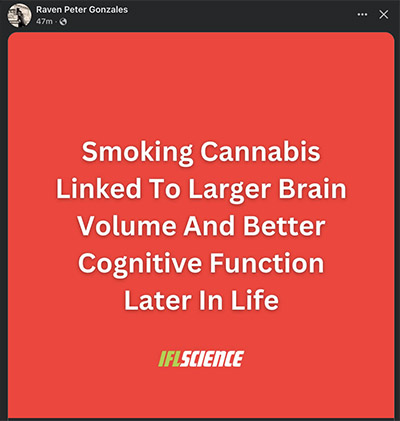
McKenzie Beard, writing in the NY Post, said researchers were “surprised” to learn that the brain benefits from cannabis usage in adults over 40. I’ve been working for decades to dispel the false and misleading narrative about cannabis use. In general, we don’t want youngsters and teens using alcohol, illicit drugs or non-prescribed medications. They bodies and brains are developing.
However, cannabis has many benefits for adults. The Nixon administration’s decision to classify cannabis as a Scheduled I substance denied research. The racist Republicans didn’t want the truth; they sought to use cannabis (marijuana) to deny freedoms and civil rights to social groups and political opponents.
Beard continues, A new study is challenging long-held assumptions about cannabis, finding that middle-aged and older adults who use the drug may actually see some brain and cognitive benefits.
The twist comes as cannabis use is climbing among older Americans. Research shows that nearly 1 in 5 people ages 50 to 64 reported using marijuana in the past year, along with 5.9% of those 65 and older. That’s notable because research on cannabis and the brain has historically zeroed in on adolescents, not aging adults.
“More older adults are using cannabis. It’s more widely available and is being used for different reasons than in younger folks — such as for sleep and chronic pain,” Dr. Anika Guha, a clinical psychologist at the University of Colorado Anschutz Medical Campus and lead author of the study.
“Plus, people are living longer. We have to ask, ‘What are the long-term effects of cannabis use as we continue to age?’”
To dig deeper, Guha and her colleagues analyzed data from 26,362 adults ages 40 to 77, with an average age of 55, all living in the UK.
Participants answered detailed questions about their cannabis use, underwent MRI scans to assess their brain structure and completed a series of cognitive tests.
The researchers zeroed in on brain regions packed with CB1 — a cannabinoid receptor they theorized would be especially affected by cannabis.
One key focus was the hippocampus, which contains a high concentration of these receptors and plays a critical role in memory as we age. It’s also a brain region closely linked to dementia.
The cognitive tests targeted mental skills previously linked to cannabis use, including learning, memory, processing speed, attention and executive function.
The researchers found that cannabis use in older adults was generally associated with larger brain volumes in several regions.
“It’s not that bigger is always better. But we also know that as we age, we often see smaller brain volumes due to processes like atrophy and neurodegeneration,” Guha said. “That decrease is often correlated with reduced cognitive function and increased dementia risk.”
Older adults who used cannabis also tended to perform better on cognitive tests, adding to a growing body of evidence suggesting the drug may have neuroprotective effects as we age.
In a Danish study, researchers found that cannabis users experienced “significantly less cognitive decline” over their lifetimes than non-users. And a US study involving patients with HIV found that those with a history of occasional cannabis use also showed stronger cognitive performance.
Even Guha didn’t expect the results to line up so cleanly. “I was a little surprised that every cognitive measure that demonstrated a significant effect showed better performance among cannabis users,” she said.
“It goes against your default assumptions,” she continued, “because I think a lot of research out there has shown cannabis is associated with worse cognitive function, at least acutely.”
That doesn’t mean lighting up nonstop is the secret to aging well. “For many of our outcome measures, moderation seemed to be best,” Guha said.
Across most brain regions and cognitive tests that showed an effect, moderate users had larger brain volumes and better cognitive performance.
Still, there were a few exceptions. In measures like right amygdala volume and visual memory and learning, heavy users posted the strongest results.
“I think that really suggests that there are dose-dependent effects,” Guha said, though she noted the study lacked detailed data on participants’ specific patterns of use.
There was also one potential downside. Higher cannabis use was linked to lower volume in the posterior cingulate — a brain region involved in memory, learning and emotional processing.
“Some research suggests a smaller posterior cingulate volume is actually associated with better working memory, so it’s a little unclear what this means,” Guha said.
“It’s a good reminder that these effects involve multiple processes,” she added. “It’s not all good or all bad.”
At the end of the day, Guha suspects cannabis’s effects on the brain depend on many factors, including how it’s used, what products people choose, why they’re using it and which stage of life researchers are studying.
“I think the main takeaway is that the story is nuanced,” she said. “Those are important questions and we’re still figuring them out.”
More answers may be on the way. Guha and her colleagues have another paper under review examining how cannabis affects brain function — not just structure — in the same group of older adults.
“These data suggest there are also positive impacts of cannabis on the function of these brain regions, not just the size or volume of them, too,” she said.
Guha is also beginning to explore the link between brain health and psilocybin use, another once-taboo substance that has gone increasingly mainstream.
“If people are using these substances, it’s worth knowing what the impacts are, both good and bad,” she said.
Remember you heard it here first. Please leave your comments below and be sure to FOLLOW ClearHeath Life Strategies. We provide News of the News You Wish You Knew.
Ko’olau of Kaua’i. I am the Defiant One
“I Believe We Can”
 ClearHealthLife Strategies
2 thoughts on “Cannabis Use Benefits the Brain in Adults Over 40”