
In the early 1990s, I began teaching and training women about fitness and nutrition science. One problem we all faced was that the “science” seemed always to be changing. Second, women frequently told me they didn’t want to lift weights, as they were afraid they would bulk up. I spoke to a woman today outside our fitness area who echoed that concern. I reminded her that she doesn’t have enough testosterone to rapidly put on muscle, but increasing her strength — particularly in her upper body — would greatly benefit her health as she ages.
SEE: Falls Among Older Adults: A Growing Crisis We Can No Longer Ignore
I wrote a series of articles during the 1990s for InfoImagination about riding on the Diet Roller-Coaster. Typically around the first of the new year, people — particularly women — commit to reduce their body weight and lose a few pounds. They would cut their intake of calories and increase exercise — what we call the “eat less and move more” weight loss approach.
In my 1998 OpEd, I reviewed an article in USA Today about “3 Fat Chicks.” These sisters, who fought obesity for most of their lives, represent millions of American women. In a desperate attempt to make progress in their fight against obesity, the sisters created a website, 3fatchicks.com, as a support system for each other and to help other women facing a similar challenge. I claimed the three ladies were on a diet roller-coaster.
SEE: Avoid the Diet Rollercoaster
Medical Science Clarified
Anna Maxted, writing in The Telegraph, features a nutritional expert, Dr. Jason Fung, and his revelatory science-based approach to weight loss is laid out in his new book, The Hunger Code. Fung argues that the “eat less, move more” is fundamentally flawed, too simplistic, and explains how we can reset our bodies to burn more fat.

Fung’s 2016 bestseller, The Obesity Code, he claimed obesity is a hormonal imbalance, not a calorific one, as having chronically high insulin levels, for instance, drives you to store fat.
Fung believes what your body does with consumed calories is what matters — how much of what you eat you burn, or store as fat. “Every single study of weight loss shows that when you just count your calories and eat less, your basal metabolic rate — the number of calories that you burn — goes down. So you could eat less, but you’ll burn less too, so still not lose that body weight.”
Fung cites three large studies, including The Women’s Health Initiative, in which participants reduced their food intake by 371 calories, and increased physical activity by 10%. “Exercise, while terrific for health, doesn’t increase calorie burn, as the body compensates by slowing metabolism afterwards.” After seven years of dieting, “they did not weigh any less than the women in the study who didn’t change their diet at all.”
In sum, the key is what your body does with your calories. “For every calorie you eat, your body could either store it or burn it. So it’s not just the number of calories that’s important. If your body stores it, you’re going to get fat. If it burns it, you’re not going to get fat.”
Good vs Bad Calories
Think in terms of “good calories” and “bad calories.” Treating all calories as equal is a recipe for weight gain. Most of us know that some foods are more fattening than others. Two hundred calories of biscuits is more fattening than 200 calories of carrot. But why? Because as well as calories, all food contains “information” for the body. Critical to weight loss (or gain) is what hormones are stimulated by the things you eat.
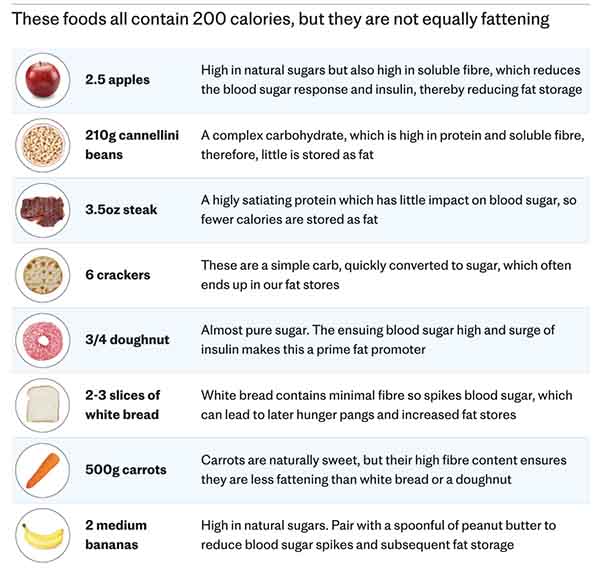
Hormones Make You Hungry
Fung claims that the most important factor determining our body weight is hormones. The hormone GLP-1 tells us to feel full. Ghrelin tells us to be hungry. Leptin tells us to lose body fat. And the hormones insulin and cortisol tell us to store body fat. So if what you eat largely stimulates insulin, you’ll gain fat.
NOTE: In normal, healthy states, leptin facilitates weight loss by promoting satiety and increasing metabolic rate. However, simply taking leptin does not cause weight loss in most overweight individuals, as they are likely resistant to its signals. Leptin levels are directly related to how much adipose tissue your body has. One study found that sleep-deprived people had high levels of ghrelin (the hunger hormone) and lower levels of leptin.
Belly fat is one form of adipose tissue. Specifically two main kinds: subcutaneous fat (under the skin) and the more dangerous visceral fat (deep around organs like the liver, intestines, and pancreas), both of which are biologically active fat cells (adipocytes) that store energy and release hormones.
To get rid of fatty tissue, combine a healthy diet (less sugar, carbs, processed foods) with regular exercise (cardio and strength training) for overall fat loss.
“If you eat an 800-calories, three-egg vegetable omelette for breakfast, you’re full. It lasts you till lunch, even dinner. If you drink an 800-calorie Starbucks frappuccino, you’re hungry five minutes later.” The calorific content is the same, but the two portions are completely different. “Why? Because they stimulate different hormones. Every food you eat contains calories, but also instructions and information on what the body should do with those calories.”
Dr. Jason Fung
When you eat that vegetable omelette, it doesn’t stimulate much insulin, Fung says. “So most of the calories are available as energy for the body.” GLP-1 is therefore released, telling us we’re full. “But after the frappuccino, insulin spikes like crazy, all of those calories immediately are stored as body fat, so you have no energy for the body.”
Your blood sugar drops and — understandably — your body sends out hunger signals by releasing a ghrelin surge. “Five minutes later, you’re thinking ‘I need something to eat.’ It’s the hormones that ultimately determine whether you gain weight or not, not the calories.”
The timing of food matters too. Even if you eat exactly the same meal in the morning and at night, “they produce very different effects on the insulin levels,” says Fung, which makes perfect sense. “Insulin’s job is to tell you to store fat, so if you eat very late at night, you’ll have about 25 per cent higher insulin levels than in the morning. It’s because you’re going to go to bed, so your body is thinking, ‘What am I going to do with all these calories? I should put them into storage’, whereas in the morning it knows you have just got up and might need the energy for the day ahead.”
Meal order also contributes to how much insulin is released. Eat fish and vegetables before pasta, eggs before toast – as fibre, fat, and protein don’t stimulate much insulin, and eating them first slows your digestion and absorption of carbs, meaning less insulin is stimulated.
Avoid eating only carbs, which Fung calls naked carbohydrates. “If you eat white bread and jam, for example, it’s all pure carbohydrate, which is all glucose.” This means it’s digested and absorbed at speed, spiking insulin. He cites experiments where participants ate two meals, “bread and orange juice, then 10 minutes later, chicken and vegetables — or you flip it around, chicken and vegetables then 10 minutes later, bread and orange juice. The insulin level is 50% lower when you eat the carbs last.”
Foods to eat on a low-insulin diet include meat and poultry, fish, eggs, cheeses, full fat yogurt, nuts and seeds, vegetables, pulses, legumes, fermented foods, fruit (low-fructose like berries), healthy fats, and spices.
Reset Your Fat Thermostat
Dr Fung believes our body keeps all its critical systems (including hydration, temperature, blood oxygen levels, and — yes — body fat) automatically in balance. These are its “homeostatic mechanisms.” How much body fat we carry is set at an optimal point called “the body set weight” by our body’s “fat thermostat”. This is because, “like wild animals who maintain relatively constant body fatness despite varying conditions” to optimise survival, we’re not meant to be very thin or fat.
And, as Fung explains, “The amount of body fat we carry is very tightly controlled.” If it’s too high or low, our body adjusts, boosting or lowering our hunger levels to reset it, then slowing or speeding up our metabolism. Or it should do. Obesity is “a disorder of the body set weight being too high”.
So how does our fat thermostat get out of whack? “There are certain hormones that push it up” — insulin, cortisol — “and there are certain hormones that push it down. If you stimulate GLP-1, like Ozempic and Mounjaro weight loss jabs do, your bodyweight goes down.”
GLP-1 hormones act indirectly on fat levels by increasing or decreasing hunger or satiety. A diet of mainly processed foods and refined carbs spikes insulin and drives hunger, overeating and weight gain. It can lead to insulin resistance — where increasing amounts of insulin are needed to clear blood glucose after eating — leading to chronically high insulin levels. This “keeps pushing that thermostat up.” Then it’s hard to sustain weight loss as your body defends that high set point.
Other hormones also affect our weight and propensity to store fat. Testosterone, higher levels of which drive the body to make muscle and burn fat, explains why teen boys can eat 5,000 calories a day (“they clean out your fridge!” exclaims Fung, who has two sons aged 19 and 22) and not gain fat. Why? “Because the hormones are directing those calories to burning.”
Estrogen is an appetite suppressant, so perimenopause — when it fluctuates and drops — is the “highest risk period of weight gain for a woman. When you have less estrogen, you tend to eat more. It’s pushing that thermostat up.” If you try to outwit it by cutting calories, your body “ramps down your metabolic rate.”
What can you do?
What you eat (or don’t) is key. “Fasting is actually a very good way to get that [thermostat] down. You turn off the food, you try to get the insulin down,” Fung says. This forces the body to burn fat for fuel.
Fung advises a low carb, high fat diet — a “low insulin diet” — plus intermittent fasting to lose weight and keep it off. He admits, “I actually have a tendency to gain weight” — but following his own advice recently enabled him to fit into some 25-year-old green trousers. “They’re awful, but I put them on anyway. My wife was not impressed!”
10 Weight-loss Tips
Add extra virgin olive oil to your diet
This is a healthy fat that stimulates your natural GLP-1, but don’t eat more than necessary. Good calories aren’t “free foods” – you can still gain weight if you eat huge portions as even in fat-burning mode, there’s only so much energy your body can burn. “You want to be burning fat, but putting in less than you’re burning,” says Fung.
Avoid UPFs [Ultra Processed Foods]
They don’t satiate, they make you hungrier, and spike insulin. They’re energy-dense but very light, containing “vanishing calories”. If food is as light as air, it tricks our body and doesn’t stimulate our fullness hormones.
Choose satiating foods
They’re naturally bulky, but not energy dense and require effort to chew and swallow (like vegetables), high in protein (like fish or eggs), high in fiber, low in sugar, low in processed fat and heavy (they feel weighty in your stomach — like beans, or whole oats). “Protein is very satiating. It can dampen appetite.” But don’t overeat protein (most do). “Because your body can’t store amino acids, any excess is turned into glucose” — then stored as fat if we don’t burn it off.
Don’t wolf your food
It takes time for satiety signals to reach the brain. People who eat slowly eat less but feel more full.
Eat whole fruits, not juiced
The physical structure of natural foods slows absorption. A whole orange’s glucose is absorbed slowly because it’s encased in fibre, whereas orange juice dumps a load of glucose into the blood fast.
Eat less often
If you eat six times a day, you’ll get hungry six times a day – your hunger hormone ghrelin is conditioned to rise. But hunger recedes when you ignore it. Practice not snacking between meals and you’ll recondition ghrelin to rise three times a day.
Fasting can simply mean skipping breakfast
This gives your body a nice long period overnight to burn fat. Just don’t overeat at lunch.
Add seeds to your smoothies
Thick soups or smoothies are more satiating than thin liquids (juice, fizzy drinks) — add chia seeds for viscosity and fibre to help slow absorption. Seeded fruit, such as passion fruit, blackberries, raspberries and strawberries in smoothies also helps slow absorption.
Remember you heard it here first. Please leave your comments below and be sure to FOLLOW ClearHeath Life Strategies. We provide News of the News You Wish You Knew.
Ko’olau of Kaua’i. I am the Defiant One
“I Believe We Can”
 ClearHealthLife Strategies